
Nationwide student protests, the political battle over the 2027 budget and an increasingly heated economic debate between the government and the opposition are adding pressure on the Euro. The single currency is trading nearly 7 percent below its January peak, while markets are watching the possibility that the French government could fall over the budget before the end of November.
The main risk is not the fall of the government
Past government crises in France did not trigger lasting or sharp moves in the Euro.
Michel Barnier’s government lost a no-confidence vote on December 4, 2024, yet the Euro gained 0.4 percent the following day. The EUR/USD exchange rate also remained relatively stable after François Bayrou’s government lost a confidence vote on September 8, 2025.
For markets, this means the more important issue is not a change of government itself, but the possibility of a deterioration in France’s borrowing conditions.
ECB bond backstop comes into focus
The European Central Bank’s Transmission Protection Instrument (TPI) allows the ECB to purchase the bonds of a Eurozone country if its borrowing costs rise rapidly for reasons not stemming from its own policies.
France must continue to meet certain conditions related to compliance with European Union fiscal rules in order to remain eligible for the mechanism. If the 2027 budget fails to pass and efforts to correct the deficit break down, France’s access to this safety net could come under scrutiny.
The fact that the ECB has never used the TPI mechanism before also makes any potential crisis involving France particularly significant.
Student protests increase pressure on the government
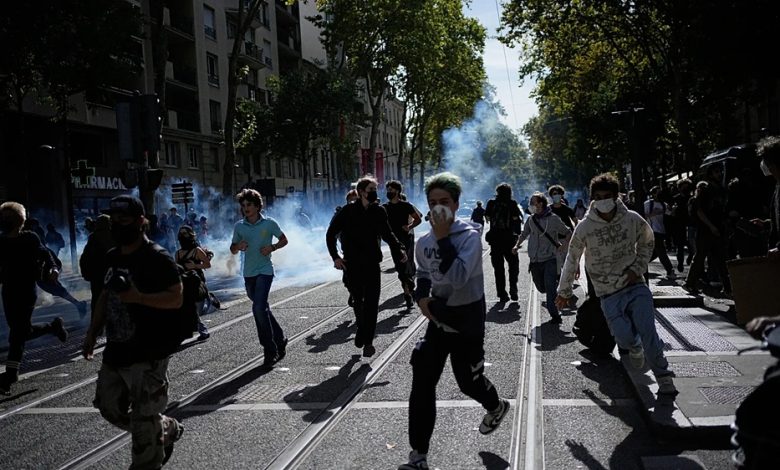
Protests that began with teachers demanding more staff and resources quickly developed into a nationwide movement led by high school students.
Hundreds of schools across the country have been fully or partially closed, while thousands of people have been detained. Students are demanding more teachers, smaller class sizes and increased funding for education.
According to Education Ministry figures, classes were fully or partially suspended at 528 high schools during the latest phase of the protests. Eighteen internal investigations were launched following allegations of police misconduct, while the government also suspended the use of stun grenades against high school students.
The 2027 budget is at the centre of the political battle
Prime Minister Sébastien Lecornu’s government is facing growing social pressure while also preparing a 2027 budget aimed at reducing the public deficit.
During the protests, the yield on France’s 10-year government bond briefly climbed above 5 percent, highlighting how political and fiscal uncertainty has begun to affect financial markets.
With the 2027 presidential election approaching, an alternative budget unveiled by National Rally leader Marine Le Pen has added another layer to the debate.
Le Pen targets €140 billion in savings
Le Pen’s plan calls for €140 billion in savings by 2032, reducing the public deficit to below 3 percent of GDP by 2030 and cutting France’s debt ratio from 119 percent to 112 percent.
The National Rally also proposes cutting taxes by €30 billion, reducing France’s contribution to the EU budget and lowering the retirement age to 62, or in some cases to 60.
Economy Minister Roland Lescure said he did not consider the plan realistic, while Public Accounts Minister David Amiel described the proposals as “a cardboard Potemkin budget”.
Source: NationalTurk